

Health Library
Pulmonary veno-occlusive disease
Pulmonary vaso-occlusive disease
Pulmonary veno-occlusive disease (PVOD) is a very rare disease. It leads to high blood pressure in the lung arteries (pulmonary hypertension).
Images
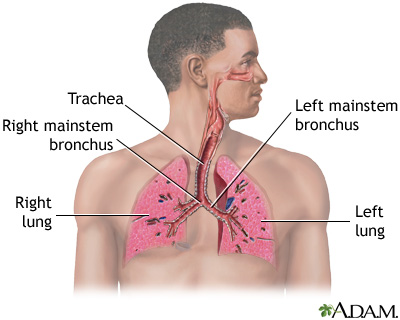
I Would Like to Learn About:
Causes
In most cases, the cause of PVOD is unknown. The high blood pressure occurs in the pulmonary arteries. These lung arteries are directly connected to the right side of the heart.
The condition may be related to a viral infection. It may occur as a complication of certain diseases such as lupus, or bone marrow transplantation.
The disorder is most common among children and young adults. As the disease gets worse, it causes:
- Narrowed pulmonary veins
- Pulmonary artery hypertension
- Congestion and swelling of the lungs
Possible risk factors for PVOD include:
- Family history of the condition
- Smoking
- Exposure to substances like trichloroethylene or chemotherapy medicines
- Systemic sclerosis (autoimmune disorder that also causes skin symptoms)
Symptoms
Symptoms may include any of the following:
- Shortness of breath
- Dry cough
- Fatigue on exertion
- Fainting
- Coughing up blood
- Difficulty breathing while lying flat
Exams and Tests
Your health care provider will examine you and ask about your medical history and symptoms.
The exam may reveal:
- Increased pressure in the neck veins
- Clubbing of the fingers
- Bluish coloration of the skin due to lack of oxygen (cyanosis)
- Swelling in the legs
Your provider may hear abnormal heart sounds when listening to the chest and lungs with a stethoscope.
The following tests may be done:
- Arterial blood gases
- Blood oximetry
- Chest x-ray
- Chest CT
- Cardiac catheterization
- Lung function tests
- Echocardiogram
- Lung biopsy
Treatment
There is currently no known effective medical treatment. However, the following medicines may be helpful for some people:
- Medicines that widen the blood vessels (vasodilators)
- Medicines that control the immune system response (such as azathioprine or steroids)
A lung transplant may be needed.
Outlook (Prognosis)
The outcome is often very poor in infants, with a survival rate of just a few weeks. Survival in adults may be months to a few years.
Possible Complications
Complications of PVOD may include:
- Difficulty breathing that gets worse, including at night (sleep apnea)
- Pulmonary hypertension
- Right-sided heart failure (cor pulmonale)
When to Contact a Medical Professional
Contact your provider if you have symptoms of this disorder.
Related Information
Pulmonary hypertensionSwelling
Breathing difficulty
References
Hoeper MM, McLaughlin V. Pulmonary hypertension. In: Goldman L, Cooney KA, eds. Goldman-Cecil Medicine. 27th ed. Philadelphia, PA: Elsevier; 2024:chap 69.
Lammi MR, Mathai SC. Pulmonary hypertension: general approach. In: Broaddus VC, Ernst JD, King TE, et al, eds. Murray and Nadel's Textbook of Respiratory Medicine. 7th ed. Philadelphia, PA: Elsevier; 2022:chap 83.
Maron BA. Pulmonary hypertension. In: Bonow RO, Mann DL, Tomaselli GF, et al, eds. Braunwald's Heart Disease: A Textbook of Cardiovascular Medicine. 13th ed. Philadelphia, PA: Elsevier; 2026:chap 80.
BACK TO TOPReview Date: 5/1/2026
Reviewed By: Warren Brenner, MD, Oncologist, Lynn Cancer Institute, Boca Raton, FL. Review provided by VeriMed Healthcare Network. Also reviewed by David C. Dugdale, MD, Medical Director, Brenda Conaway, Editorial Director, and the A.D.A.M. Editorial team.
 | A.D.A.M., Inc. is accredited by URAC, for Health Content Provider (www.urac.org). URAC's accreditation program is an independent audit to verify that A.D.A.M. follows rigorous standards of quality and accountability. A.D.A.M. is among the first to achieve this important distinction for online health information and services. Learn more about A.D.A.M.'s editorial policy, editorial process and privacy policy. A.D.A.M. is also a founding member of Hi-Ethics. This site complies with the HONcode standard for trustworthy health information: verify here. |
The information provided herein should not be used during any medical emergency or for the diagnosis or treatment of any medical condition. A licensed medical professional should be consulted for diagnosis and treatment of any and all medical conditions. Links to other sites are provided for information only -- they do not constitute endorsements of those other sites. No warranty of any kind, either expressed or implied, is made as to the accuracy, reliability, timeliness, or correctness of any translations made by a third-party service of the information provided herein into any other language.
© 1997-
2026 A.D.A.M., a business unit of Ebix, Inc. Any duplication or distribution of the information contained herein is strictly prohibited.
All content on this site including text, images, graphics, audio, video, data, metadata, and compilations is protected by copyright and other intellectual property laws. You may view the content for personal, noncommercial use. Any other use requires prior written consent from Ebix. You may not copy, reproduce, distribute, transmit, display, publish, reverse-engineer, adapt, modify, store beyond ordinary browser caching, index, mine, scrape, or create derivative works from this content. You may not use automated tools to access or extract content, including to create embeddings, vectors, datasets, or indexes for retrieval systems. Use of any content for training, fine-tuning, calibrating, testing, evaluating, or improving AI systems of any kind is prohibited without express written consent. This includes large language models, machine learning models, neural networks, generative systems, retrieval-augmented systems, and any software that ingests content to produce outputs. Any unauthorized use of the content including AI-related use is a violation of our rights and may result in legal action, damages, and statutory penalties to the fullest extent permitted by law. Ebix reserves the right to enforce its rights through legal, technological, and contractual measures.
